
Taking on a new employee is an exciting step for any small business or charity, but there's plenty to organise before their first day, from contracts and references to payroll and other paperwork.
One important task you can't afford to overlook is completing the appropriate right to work checks before your new employee starts work.
But what exactly do employers need to check, which documents are acceptable, and how do you make sure you've followed the correct process?
In this guide, we'll explain how to carry out right to work checks in the UK, when they're required and what records you need to keep.
What is a right to work check?
A right to work check is the process employers must follow to confirm that someone is legally allowed to work in the UK and undertake the particular job they're being offered.
It's not simply about checking someone's identity. You also need to establish that they have permission to do the work, including whether there are any restrictions on the type of work or number of hours they can undertake.
Don't assume that collecting their National Insurance number is enough either. A National Insurance number on its own doesn't prove someone's right to work in the UK.
Why do small businesses need to carry out right to work checks?
Regardless of whether you employ two people or two hundred, you have a legal responsibility to ensure that the people working for you have the appropriate right to work in the UK before the individual starts work.
Carrying out the correct checks:
Helps protect your business from employing someone who isn't legally permitted to work.
Provides what's known as a statutory excuse which means that, if you have carried out the checks correctly, you may be protected against a civil penalty if an employee is subsequently found to be working illegally.
The consequences of getting this wrong can be significant, with civil penalties of up to £60,000 per illegal worker, depending on the circumstances.
For small businesses and charities, particularly those making their first few hires, knowing what needs to be done is often only half the challenge. Finding the time to manage the paperwork, keep accurate records and make sure nothing gets missed can be just as difficult. That's why having a clear, consistent onboarding process is so valuable, and where having some practical Recruitment & HR Support can make a real difference.
Who needs a right to work check?
Right to work checks aren't just for employees coming to the UK from overseas. Employers must check that everyone they employ has the legal right to work in the UK, regardless of their nationality or how long they've lived here.
This includes:
Full-time and part-time employees
Temporary and fixed-term employees
Apprentices
From 1 October 2026, the requirements were extended to cover additional working arrangements, including:
Individuals engaged under a worker's contract, rather than a traditional employment contract
Certain individual subcontractors
Individuals whose services are offered through qualifying online matching services, where the service operator has responsibility for the checks.
The rules can also affect businesses receiving workers through other organisations, depending on the contractual arrangements.
If you're engaging freelancers, contractors or casual workers, it's important not to assume they're automatically exempt from right to work requirements. Whether checks are required will depend on the nature of the working relationship.
It's also important to be consistent. You shouldn't make assumptions about someone's right to work based on their name, appearance, accent or nationality. Checks should be applied fairly across your recruitment and onboarding process.
When should a right to work check be completed?
The initial check must be completed before the individual starts working for you. Ideally, it should form part of your pre-employment process, alongside obtaining references, preparing the employment contract and gathering the information needed for payroll.
Hiring an employee with time-limited permission to work? You may also need to carry out follow-up checks at the appropriate time. See below.
How do employers carry out a right to work check?
Right to work checks don't have to be complicated. Once you understand what's required, they're a relatively straightforward part of your recruitment and onboarding process.
There are three main methods of carrying out a right to work check. Manual checks can be completed either in person or remotely, provided the relevant requirements are met.
| Checking method | When to use this method |
|---|---|
| Manual document check (in-person) | When the applicant is an eligible British or Irish citizen and can provide acceptable original documents for you to check in person. |
| Manual document check (remote) | In circumstances where an in-person right to work check isn’t possible, a live video call can be used to conduct this check, provided the applicant sends the original documents to the employer (e.g. by post) and the employer has the original documents in their possession, not merely digital copies. |
| Home Office online check | When the applicant has an eVisa or other eligible digital immigration status and can provide a right to work share code. Suitable for remote checks. |
| Digital verification service provider | For eligible British and Irish citizens who have the required passport documentation. A digital verification service provider can verify their identity remotely, but the employer remains responsible for reviewing the results, confirming they relate to the applicant and retaining the required evidence. |
Regardless of the route chosen, there are three main stages to the check:
Obtain the correct evidence of the individual's right to work.
Check that the evidence is valid and confirms they can undertake the role.
Keep a secure record showing that the check was completed correctly.
The documents and checking method will depend on the individual's circumstances. Here's what each stage involves:
Step 1: Obtain the correct right to work evidence
For British and Irish citizens
This will often involve checking an original passport or, where permitted, using an approved digital verification service provider. Important note: A photograph or scanned copy of a passport sent by the applicant is not, on its own, a valid manual right to work check.
For individuals with digital immigration status, such as an eVisa
You'll normally need to use the Home Office's online right to work checking service. The applicant provides you with a right to work share code and their date of birth, which you enter into the government service to view their status.
Step 2: Check that the evidence is valid
Once you have the appropriate documents or online result, you need to confirm that the individual is who they say they are and that they're permitted to undertake the job you're offering.
For a manual document check, you must examine the original documents and confirm they belong to the applicant, either in person or through a live video call while you have the originals in your possession. The purpose of these checks is to make sure that:
The documents are genuine, original and haven't been tampered with.
The photographs match the individual you are employing.
The dates of birth are consistent across documents.
The names match. Where they differ, changes must be supported by appropriate evidence, such as a marriage certificate or divorce decree.
The documents demonstrate the individual's right to work.
For employers hiring a remote employee or other circumstances where an in-person right to work check isn’t possible, a live video call can be used to conduct this check, provided the employer has the original documents in their possession, not merely digital copies.
For an online check, you'll need to confirm that the photograph matches the applicant and review any restrictions shown. For example, someone may have permission to work in the UK but be restricted in the number of hours they can work, or the type of employment they can undertake. Or, if you're employing a student, there may also be restrictions relating to their term-time working hours.
If something doesn't look right, or you're unsure whether the evidence is sufficient, seek clarification before allowing the individual to start work.
Step 3: Keep evidence of the check
Completing the check is only part of the process. You also need to demonstrate that you've done it correctly.
For manual document checks, this generally means:
Taking a clear, unalterable copy of the relevant documents.
Recording the date the check was completed.
Storing the copies securely.
For an online right to work check, you should save the Home Office results page showing the individual's photograph, right to work status and the date of the check.
For checks completed through a digital verification provider, you should keep a copy of the provider's right to work check report, including the required identity verification information and date of the check.
These records must be retained securely throughout the individual's employment and for a further two years after they leave, after which they should be securely destroyed.
As these documents contain personal information, you'll also need to make sure they're stored and handled appropriately under data protection legislation. For small businesses, this could be as straightforward as having a secure, access-controlled employee folder and a consistent checklist for every new starter.
Which right to work check should employers use?
Use our handy decision-tree flowchart to identify the most suitable verification route for your new starter.
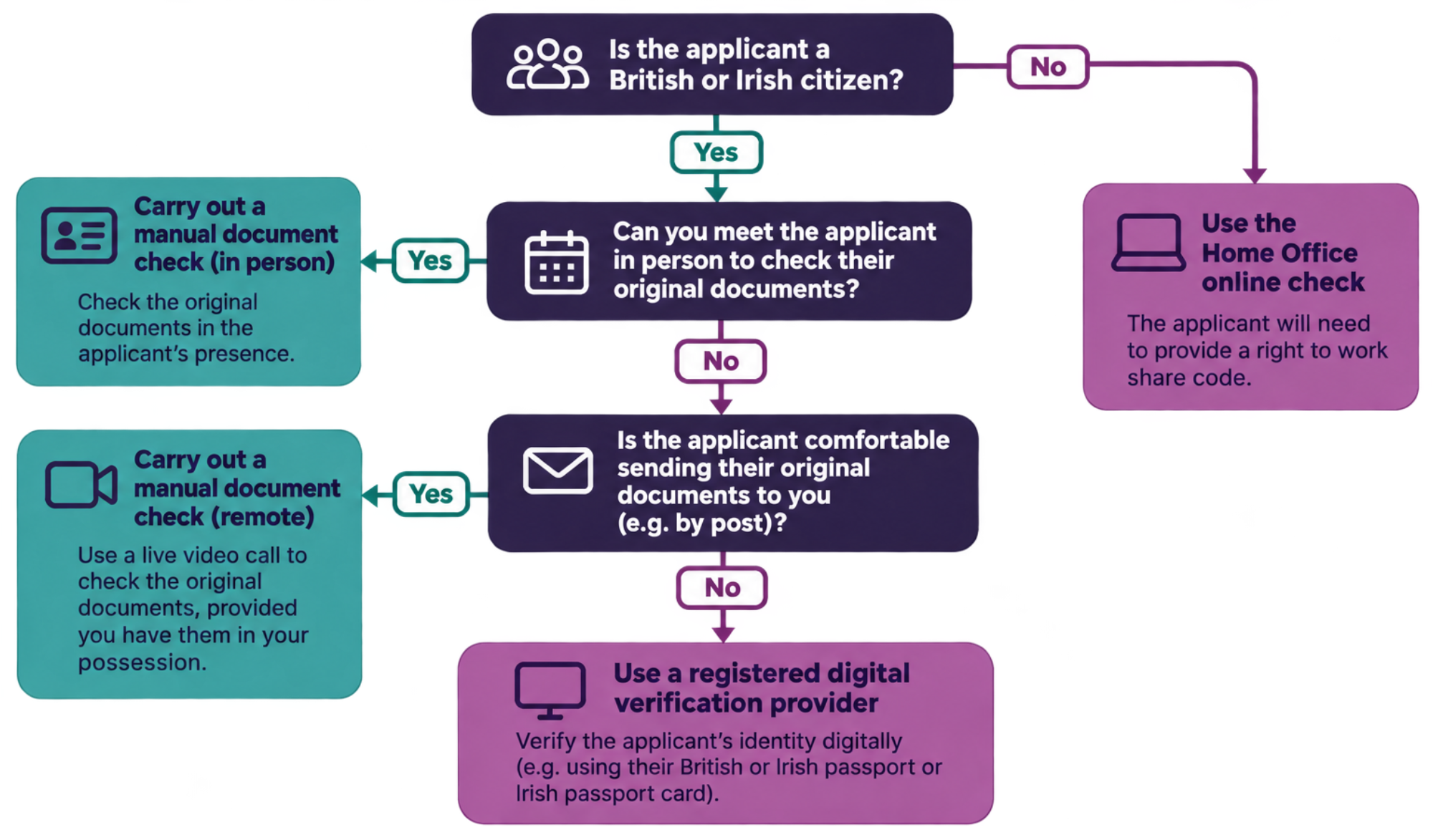
Flowchart showing how UK employers can choose between manual document checks,
Home Office online right to work checks and digital verification services.
Important notes:
Digital verification is only suitable for eligible British and Irish citizens with the required passport evidence. Applicants without a passport may need to use an alternative manual document combination.
For non-British and non-Irish applicants, use the Home Office online service where their immigration status permits it. Otherwise, consult the official guidance for alternative checks, including the Employer Checking Service where appropriate.
FAQs about right to work checks
Do right to work checks need to be conducted in person?
No, right to work checks can be completed remotely, but the process depends on the nationality of the person you’re hiring and the checking method you're using.
Manual document checks (British and Irish citizens only): You can check someone's documents over a live video call, but you must have the original documents physically in your possession (i.e. if they have securely sent the originals to you). Simply viewing documents on screen or receiving scanned copies by email isn't sufficient.
Digital verification services (British and Irish citizens only): For eligible British and Irish citizens, you can use a registered digital verification service provider to complete the identity verification process.
Home Office online checks (non-British and Irish citizens only): You can use the applicant's share code and date of birth to check their right to work online. You must also confirm that the photograph matches the applicant, either in person or remotely.
Whichever method you use, you must complete the appropriate checks and retain the required evidence before the individual starts work.
Do right to work checks need to be repeated?
Not always. If an employee has an unrestricted right to work in the UK and you've completed the appropriate check, you won't normally need to repeat it.
However, where an individual's permission to work is time-limited, you may need to carry out a follow-up check before their permission expires, or at another point required by the Home Office rules. It's worth recording any relevant dates and setting reminders so that checks aren't missed.
Are right to work checks the same as DBS checks?
No, and this is an important distinction, particularly for charities and organisations working with children or vulnerable adults.
A right to work check confirms whether someone is legally permitted to work in the UK.
A Disclosure and Barring Service (DBS) check provides information about an individual's criminal record and, where applicable, whether they're barred from certain types of work.
Depending on the role, you may need to complete both checks as part of your safer recruitment process. One doesn't replace the other.
Can an employee start work while their right to work check is being completed?
No. You must complete the appropriate right to work check before the employee starts work. If they cannot provide the usual evidence, the Home Office Employer Checking Service may be able to help you establish their right to work.
How do I conduct a right to work check on a British or Irish applicant who doesn’t have a passport?
Don't worry, a passport isn't the only acceptable way to prove someone's right to work in the UK.
Depending on the applicant's circumstances, you may be able to use an appropriate birth or adoption certificate, or a certificate of registration or naturalisation as a British citizen, together with official evidence of their name and permanent National Insurance number. Check the Home Office's list of acceptable documents to confirm which combination applies.
As with any manual right to work check, you'll need to examine the original documents, check they belong to the applicant, and keep copies along with a record of when the check was completed.
For the full list of acceptable documents, refer to the Home Office right to work checklist.
Making right to work checks part of your recruitment and onboarding process
Don't treat right to work checks as a one-off task you need to remember each time you recruit. Build them into your standard onboarding process, alongside references, employment contracts and payroll information.
That way, you have a consistent process for every new starter, know what evidence needs to be collected and can be confident that important checks aren't being overlooked. Creating a simple checklist, with clear responsibilities and a secure place to store records is a small piece of administration that can help protect your business and make future recruitment much easier. It's also a good example of why documenting your business processes can make such a difference, particularly as your team grows.
Need a hand with your recruitment and onboarding admin?
Recruiting someone new is an exciting step, but there's often more paperwork and administration involved than you might expect, particularly when you're managing everything yourself.
At By Your Side Business Support, we help small businesses and charities take care of the practical side of recruitment and onboarding, from preparing employment documentation and coordinating pre-employment checks to creating checklists and keeping employee records organised.
Whether you're taking on your first employee or looking to improve the processes you already have in place, we can help make things a little easier.
Need a little help getting everything in place?
Take a look at our Recruitment & HR Support, or book a discovery call to have a chat about how we can help.
Further information
For the latest official guidance, visit:
Disclaimer:
This article provides general guidance based on the UK rules in place in November 2026. Right to work requirements can change, so always refer to the latest Home Office guidance for your particular circumstances.
